
Article: The Ultimate Lifter's Nutrition Guide

The Ultimate Lifter's Nutrition Guide
Everything You Need to Eat to Reach Your Goals
Set Lifting | Nutrition Corner
Your training only works if your nutrition does. Here is the no-fluff guide to fueling your body for fat loss, muscle gain, or both. Works for men and women, beginner to advanced.
Bookmark this. You will come back to it.
Step 1: Pick Your Goal
Three paths. Pick one and commit for at least 8 to 12 weeks. Trying to do all three at once is why most people get stuck.
Cutting — Lose fat, keep muscle. Eat less than you burn.
Bulking — Build muscle, gain strength. Eat more than you burn.
Maintenance — Lose fat and gain muscle slowly at the same weight.
Step 2: Find Your Calories
Quick Estimate of Your Daily Calorie Burn (TDEE)
Mostly Sedentary: Bodyweight (lbs) x 13
Moderately Active (lift 3 to 5x per week): Bodyweight (lbs) x 15
Very Active (daily training): Bodyweight (lbs) x 17
Adjust Based on Your Goal
| Goal | Adjustment |
|---|---|
| Cutting | TDEE minus 300 to 500 calories |
| Bulking | TDEE plus 200 to 400 calories |
| Maintenance | No change |
Pro Tip: Start small. Aggressive cuts or bulks make you quit by week three. Sustainable wins.
Step 3: Hit Your Macros
Protein — Non-Negotiable
Builds muscle, repairs tissue, keeps you full.
Target: 0.8 to 1g per pound of bodyweight every day.
Carbs — Your Fuel
Don't fear them. They power your lifts.
Training Days: 1 to 3g per pound
Rest Days: Reduce by 20 to 30%
Fats — Essential
Hormones, recovery, joint health.
Target: 0.35 to 0.5g per pound. Never drop below 20% of total calories.
Best Food Sources
| Protein | Carbs | Fats |
|---|---|---|
| Chicken Breast | White Rice | Avocado |
| Lean Ground Beef | Sweet Potato | Olive Oil |
| Salmon, Tuna | Oats | Almonds, Peanut Butter |
| Eggs, Egg Whites | Bananas, Fruit | Egg Yolks |
| Greek Yogurt | Whole Grain Bread | Salmon |
| Cottage Cheese | Pasta, Quinoa | Cheese (Moderate) |
| Whey or Plant Protein | Beans, Lentils | Walnuts, Cashews |
Step 4: What to Eat Around Your Workout
Before Training (1 to 2 Hours Before)
Protein and carbs. Low fat, low fiber. You want energy, not a heavy stomach.
Chicken and Rice
Eggs, Toast, and a Banana
Greek Yogurt, Oats, and Berries
Protein Shake with Banana and Peanut Butter
Quick Option (30 Minutes Before)
Banana and a Handful of Almonds
Rice Cake and Peanut Butter
Small Protein Shake
After Training (Within 30 to 60 Minutes)
Prioritize protein for muscle repair and carbs to refuel glycogen.
Lean Beef or Chicken, Rice, and Vegetables
Protein Shake, Banana, and Rice Cakes
Salmon, Sweet Potato, and Asparagus
Tuna, Rice, and Avocado
Step 5: Sample Meal Plans
Cutting — Women (About 1,800 Calories)
| Meal | Foods |
|---|---|
| Breakfast | 3 egg whites, 1 whole egg, half cup oats, half cup berries |
| Lunch | 150g grilled chicken, large salad, olive oil, half cup quinoa |
| Pre-Workout | 1 banana and 1 tbsp almond butter |
| Post-Workout | Protein shake, 1 cup white rice, broccoli |
| Dinner | 150g salmon, 1 sweet potato, roasted asparagus |
| Evening Snack | 150g Greek yogurt and 1 tsp honey |
Cutting — Men (About 2,400 Calories)
| Meal | Foods |
|---|---|
| Breakfast | 4 whole eggs, 2 egg whites, 1 cup oats, 1 banana |
| Mid-Morning | 200g Greek yogurt and a handful of almonds |
| Lunch | 200g lean ground beef, 1.5 cups rice, mixed vegetables |
| Pre-Workout | 1 banana and a protein shake |
| Post-Workout | 200g chicken breast, 1.5 cups white rice, broccoli |
| Dinner | 200g salmon, 1 sweet potato, large green salad |
Bulking — Women (About 2,200 Calories)
| Meal | Foods |
|---|---|
| Breakfast | 3 eggs, 2 egg whites, 1.5 cups oats, banana, honey, milk |
| Mid-Morning | Protein shake, peanut butter, 1 cup oats |
| Lunch | 180g chicken thigh, 2 cups rice, avocado, olive oil |
| Pre-Workout | 2 rice cakes, peanut butter, honey |
| Post-Workout | Protein shake, banana, 1 cup rice |
| Dinner | 200g lean beef, 1.5 cups pasta, tomato sauce, parmesan |
Bulking — Men (About 3,200 Calories)
| Meal | Foods |
|---|---|
| Breakfast | 5 eggs, 2 cups oats, banana, milk, 2 slices toast with peanut butter |
| Mid-Morning | Protein shake, 1.5 cups oats, peanut butter |
| Lunch | 250g chicken thigh, 2.5 cups rice, avocado, olive oil |
| Pre-Workout | 3 rice cakes, peanut butter, banana |
| Post-Workout | Protein shake, 2 cups rice, banana |
| Dinner | 250g lean beef, 2 cups pasta, tomato sauce, parmesan |
Step 6: Hydration
Just 2% dehydration can drop your strength by 10 to 20%. Water is your most overlooked performance tool.
Daily Target: Half your bodyweight in pounds, in ounces of water.
Add: 16 to 25 oz extra for every hour of training.
Start every morning with 16 oz before anything else.
Sip during workouts, don't wait until thirsty.
Add electrolytes on heavy training days.
Pale yellow urine is your sign you're hydrated.
Step 7: Cutting Done Right
Five Rules
1. Never drop below 1,200 calories (women) or 1,500 calories (men).
2. Keep protein high — 1g per pound of bodyweight.
3. Don't cut carbs to zero — keep them on training days.
4. Eat high-volume foods: greens, lean meats, broth-based soups.
5. Add 20 to 30 minutes of cardio 3 to 4x per week.
How Fast Should You Lose?
0.5 to 1% of bodyweight per week. Faster than that, you're losing muscle.
Step 8: Bulking Done Right
Lean Bulk vs Dirty Bulk
Lean Bulk: 200 to 300 calories over TDEE. Best for almost everyone.
Dirty Bulk: 500+ over TDEE. Faster but mostly fat gain. Skip it.
Four Rules
1. Train hard enough to justify the food — progressive overload required.
2. Keep protein at 0.8 to 1g per pound.
3. Bulk for at least 12 to 16 weeks before evaluating.
4. Track your lifts, not just the scale.
How Fast Should You Gain?
0.25 to 0.5% of bodyweight per week. Slow and steady builds muscle, not fat.
Step 9: Meal Timing Basics
Pre-Workout: Eat 1 to 2 hours before. Protein and carbs, low fat.
Post-Workout: Eat within 30 to 60 minutes. 30 to 40g protein + 50 to 80g carbs.
Frequency: 3 meals plus 1 to 2 snacks works for most lifters.
Protein Spacing: Don't go more than 4 to 5 hours without protein.
Late Night Eating: Total daily intake matters more than timing.
Step 10: Key Micronutrients
| Nutrient | Why You Need It | Top Sources |
|---|---|---|
| Vitamin D | Testosterone, bones, immunity | Sunlight, salmon, eggs |
| Magnesium | Sleep, recovery, strength | Dark chocolate, spinach, almonds |
| Zinc | Testosterone, immunity | Beef, oysters, pumpkin seeds |
| Iron | Oxygen to muscles (key for women) | Red meat, spinach, lentils |
| Omega-3 | Reduces inflammation, joint health | Salmon, sardines, walnuts |
| Potassium | Muscle contractions, hydration | Banana, sweet potato, avocado |
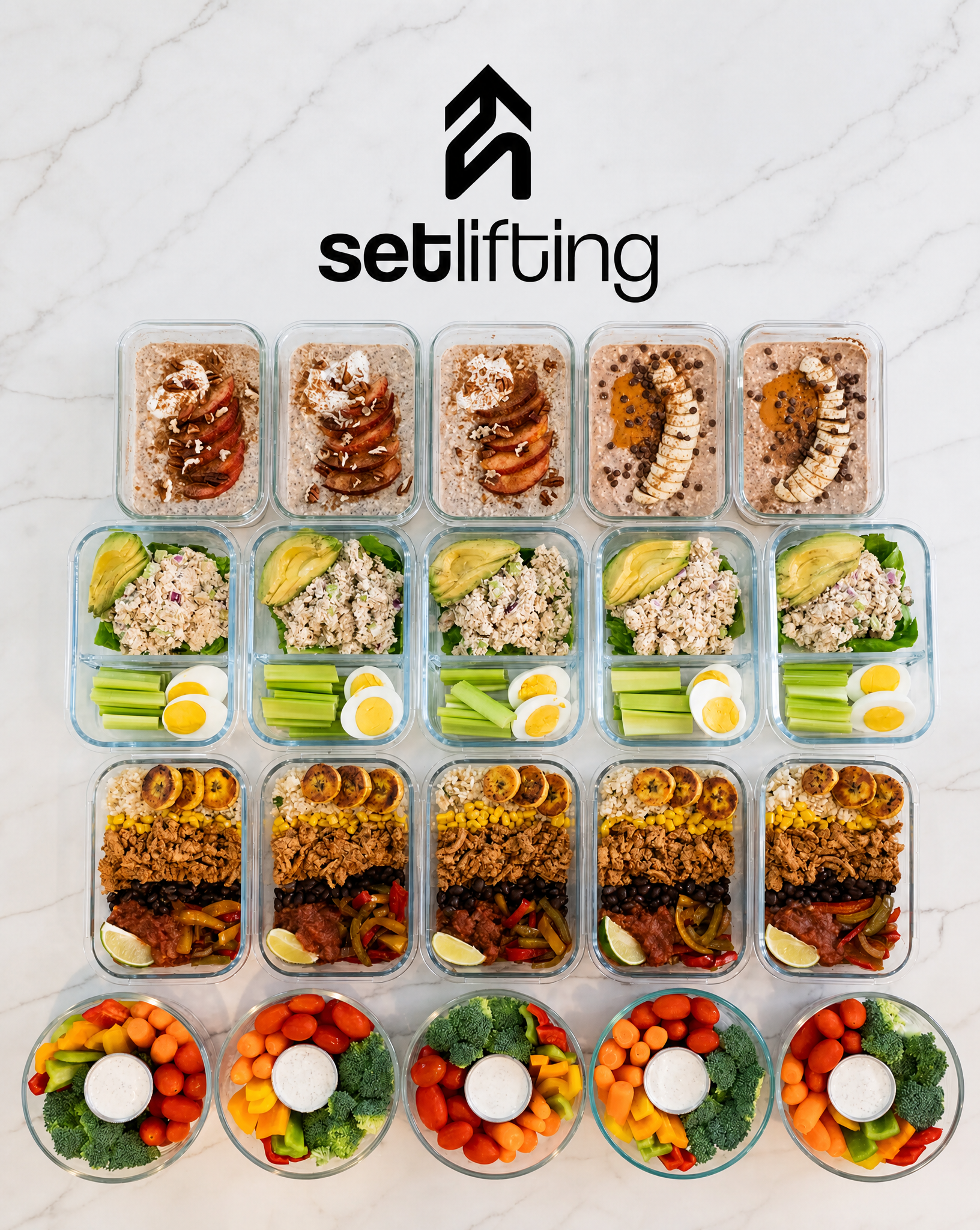
Step 11: 2-Hour Meal Prep Guide
Meal prep is the single biggest habit separating people who hit their goals from people who don't.
Hour 1
Cook 2 lbs of chicken breast in the oven (400F for 25 minutes).
Cook 4 cups of white rice in a rice cooker.
Roast 2 trays of vegetables (broccoli, peppers, zucchini, olive oil, 400F for 20 minutes).
Hour 2
Boil 10 to 12 eggs.
Portion Greek yogurt or cottage cheese into containers.
Cut and prep fruit for snacks.
Portion everything into daily containers, labeled Monday through Friday.
Result: 5 days of lunches, dinners, snacks, and post-workout meals ready to grab. Cost: Roughly $60 to $80 per week.
Quick FAQ
Do I Need to Count Calories?
Not forever, but track for 2 to 4 weeks. It teaches portion sizes and macro awareness you'll use for life.
Can I Drink Alcohol and Still Make Progress?
Occasionally yes. Keep it to 1 to 2 drinks max and avoid it before heavy training days.
What About Cheat Meals?
One per week on a cut won't hurt. The problem is when one meal becomes a full cheat day.
Is It Bad to Eat Late at Night?
No. Total daily intake matters more than timing. A protein snack before bed actually helps overnight recovery.
How Long Until I See Results?
Energy changes in 1 to 2 weeks. Visible body composition changes in 4 to 8 weeks of consistency.
Should Women Eat Differently Than Men?
Same principles, smaller portions. Pay extra attention to iron and calcium.
Do I Need a Multivitamin?
Not really, if you eat varied whole foods. But Vitamin D, Omega-3, and Magnesium are worth supplementing for most lifters.
Coming Up Next
This guide covers food, the foundation. Next post we'll cover supplements that actually matter:
Protein Powder: Whey vs plant, when to use it.
Creatine: The most researched supplement in sports science.
Pre-Workout: What works, what's just marketing.
Omega-3, Vitamin D, Magnesium: The basics every lifter should know.
Stay consistent. Train hard. Eat with intent.
Your results are built in the kitchen just as much as in the gym.
Set Lifting | setlifting.com
Disclaimer: This article is for informational purposes only and does not constitute medical or nutritional advice.